5 Signs Your Baby Is Ready to Stop Swaddling
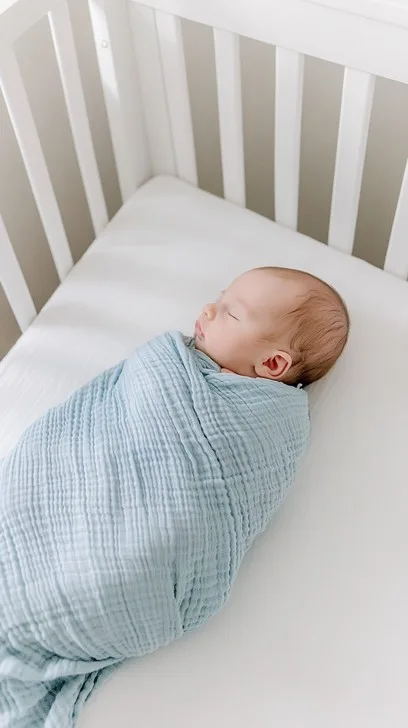
Every parent asks the same quiet question around the two-month mark: is my baby ready to ditch the swaddle? Knowing how to recognize when swaddling should stop comes down to three signals, and your baby will show at least one of them before you'd ever guess. The trick is catching them early, because one of them is a genuine safety deadline rather than a suggestion.
In our research across American Academy of Pediatrics guidance and manufacturer swaddle labels, the pattern is consistent: swaddling must end at the first sign of rolling, which can happen as early as 8 weeks, or when the Moro reflex fades around 3 to 6 months. Most swaddle products also carry a hard weight cap, often 12 to 18 pounds, whichever milestone arrives first. Let's break down exactly what to watch for and what to do next.
Image source: Web (Bing) / stockcake.com (Web image (fair-use with source credit))
Why Swaddling Has an Expiration Date (and Why Most Parents Miss It)
Swaddling works because it mimics the womb. It dampens the Moro reflex, which is the involuntary arm-flailing startle response newborns are born with. That reflex is your ally for the first couple of months and then becomes the reason to move on.
Here's the part that trips parents up. The safest sleep position for a swaddled baby is on the back. But once a baby can roll, a swaddled baby who flips onto their stomach can't use their arms to push up or reposition.
That's why the American Academy of Pediatrics is blunt on this point: stop swaddling at the first sign of rolling, full stop.
The other reason is physics, not safety. Babies grow fast. A swaddle that fit at 8 pounds is chokingly snug at 14.
Manufacturer specifications indicate most swaddles top out between 12 and 18 pounds or a listed age range, and stretching past those limits means either a broken swaddle or a baby whose hips and legs can't move freely.
Quick Answer: The Signs Your Baby Is Ready to Stop Swaddling
Knowing how to recognize when swaddling should stop comes down to three signs. Watch for your baby's first roll attempt, usually around 3 to 4 months. Watch for the startle reflex fading, typically between 3 and 6 months.
Watch for your baby actively fighting the swaddle. Any one of these means it's transition time.
The Three Triggers That End Swaddling: Rolling, Reflex Fade, and Resistance
These three signals show up in a different order for every baby. Here's what each one actually looks like in real life.
Trigger 1: The first roll attempt. This is the non-negotiable one. You'll usually spot it during tummy time first: your baby rocks onto their side or gets a shoulder over. Some babies do it in the crib before you ever see it on the floor.
The moment you see anything roll-like, the swaddle is done. No weaning period, no "one more week."
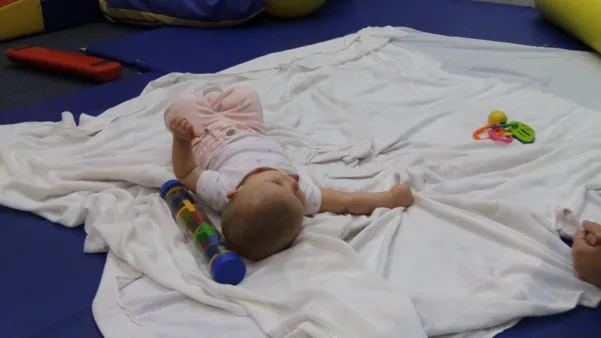
Image source: Bing (Web (fair-use with source credit))
Trigger 2: The Moro reflex fading. The startle reflex peaks in the first month and fades gradually. If your baby sleeps fine with one arm loose, or startles less dramatically at normal household noise, the reflex is on its way out. That's your green light to start weaning, not a panic deadline.
Trigger 3: Swaddle resistance. Some babies simply decide they're done. Signs include crying when you wrap them, busting arms out within minutes, or sleeping better in a car seat or swing with arms free. Babies fight the swaddle either because the reflex is fading or because they run hot.
Either way, they're telling you something.
A quick note on cold hands. Babies' hands run cool even when their core is perfectly warm. Check the chest or back of the neck instead.
If those are warm and dry, your baby isn't cold, and cool hands are not a reason to swaddle longer.
Decision Guide: Which Signal Are You Seeing?
This is where it becomes a simple if/then decision. Find your situation below and follow the branch.
| Signal you're seeing | What it means | What to do |
|---|---|---|
| Any roll attempt, even partial | Safety deadline hit | Stop swaddling that night. Go straight to a sleep sack. |
| Startle reflex fading, baby 3+ months | Natural window open | Start gradual weaning: one arm out for 3-7 nights, then both. |
| Baby fighting the swaddle | Reflex fading or overheating | Test one arm out. If sleep improves, keep going. |
| Baby under 8 weeks, no signals | Not yet | Keep swaddling safely. Recheck weekly. |
| Baby hits product weight limit | Fit no longer safe | Stop regardless of milestones. Transition now. |
If rolling is your signal
Skip the gradual approach entirely. The risk isn't worth the easier transition. Use a sleep sack, which leaves arms free but keeps the rest of the body covered and warm.
Expect a few rough nights. That's temporary.
If the reflex fade or resistance is your signal
You have room to wean gradually, which usually means better sleep for everyone. We'll cover the exact method below.
How to Transition Out of the Swaddle Without Losing Sleep
For most families, the gradual path works best. It takes about a week, sometimes two. Here's the sequence.
One arm out, then both
Start by leaving your baby's dominant arm out of the swaddle for three to seven nights. Sleep may be choppy at first, and that's normal. The startle wakes them, they fuss, you settle them.
Most babies adjust within a few nights.
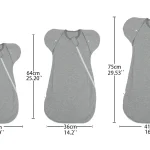
Once one arm is going fine, release both arms. Some babies handle this in the same swaddle with the wrap lowered. Others do better moving straight to the next stage.

Image source: Web (Bing) / parents2b.com.au (Web image (fair-use with source credit))
Two things make this easier:
- White noise. It buffers the small sounds that used to trigger the startle reflex, which is exactly what the swaddle was doing.
- Consistency. Don't swaddle some nights and not others. Babies adapt faster to a predictable routine.
If your baby is genuinely miserable for four or five straight nights, that's feedback. Some babies do better going cold turkey to a sleep sack than enduring a week of half-measures.
Moving to a sleep sack
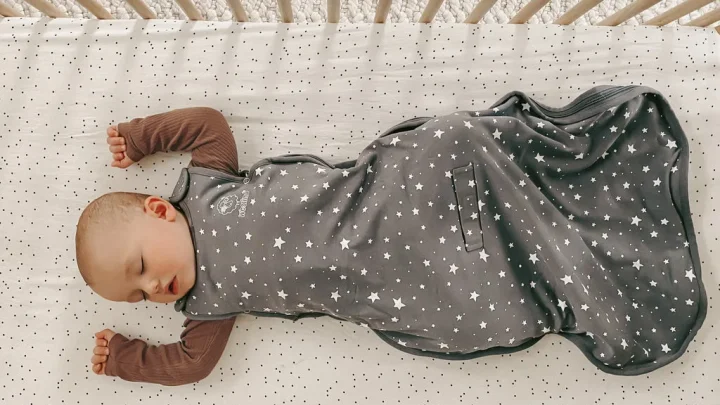
A sleep sack, sometimes called a wearable blanket, is the destination for every baby eventually. It keeps legs and torso covered without anything loose in the crib, and arms stay free for repositioning and self-soothing.
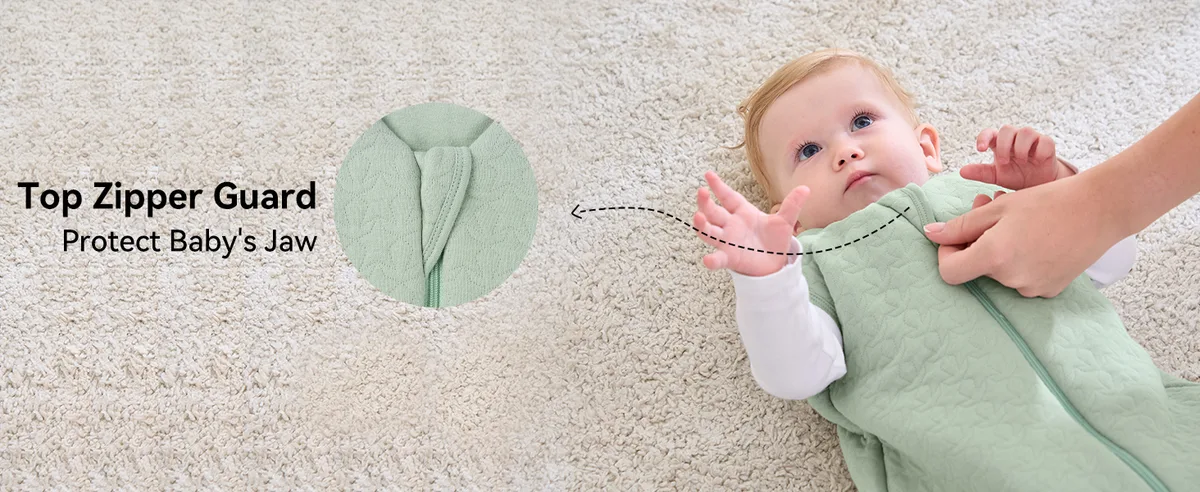
Image source: Bing (Web (fair-use with source credit))
The one spec that matters here is the TOG rating, which measures fabric warmth. Per standard thermal guidance, match the TOG to your nursery temperature rather than guessing:
| Nursery temperature | Suggested TOG | Layering |
|---|---|---|
| 75°F+ (24°C+) | 0.2-0.5 | Onesie only |
| 68-74°F (20-23°C) | 0.5-1.0 | Onesie or short-sleeve bodysuit |
| 61-67°F (16-19°C) | 1.0-2.0 | Bodysuit plus footed pajamas |
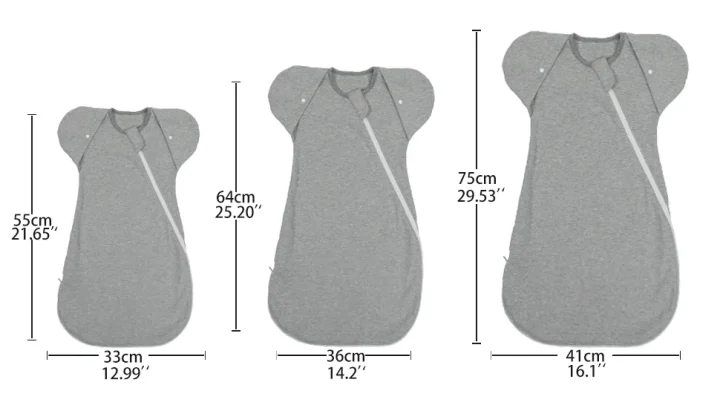
Size the sleep sack by weight, not age. The CDC's safe sleep guidance recommends back sleeping with no loose blankets, and a properly sized sleep sack keeps you compliant with that without a second thought. Once both arms are out and the sleep sack is on, the transition is done.
Most families report the whole thing settles within three to seven nights.
Common Mistakes That Keep Parents Swaddling Too Long
The most common mistake is anchoring to age instead of milestones. Parents hear "swaddle until 3 months" and treat it as a schedule. Your baby's development doesn't follow a calendar, so watch behavior, not weeks.
The second mistake is re-swaddling after every bad night. One rough night during weaning doesn't mean your baby isn't ready. If you re-wrap at the first setback, you'll restart the transition every week for months.
A few more we've seen repeatedly:
- Waiting for a "perfect" week. There's never a regression-free window. Pick a weekend and commit.
- Downgrading to a loose blanket swaddle. A loosely wrapped blanket is both unsafe and useless. It comes undone and violates the no-loose-bedding rule.
- Ignoring the weight limit on the swaddle label. If the product says 14 pounds, 15 pounds isn't close enough.
- Transitioning naps and nights at different times. Do both at once. Babies adapt faster when the rule is consistent everywhere.
One honest caveat: daycare complicates this. Many licensed centers require arms-out by a set age regardless of your home routine. If your baby attends daycare, ask their policy before starting.
Aligning both settings at once saves weeks of back-and-forth.
Safety Rules You Can't Skip (AAP Guidance, Hip Health, and Overheating)
Three safety issues deserve their own space, and two apply even before the transition.
Hip health comes first. The International Hip Dysplasia Institute warns that tight leg swaddling forces the hips into a straightened position, which raises developmental dysplasia risk. A hip-healthy swaddle is snug at the chest and loose at the hips, allowing the legs to bend and frog out naturally. If your swaddle immobilizes the legs, stop using it now.
Overheating is the silent one. Signs of overheating include a flushed face, sweating, rapid breathing, and a hot chest. Check the chest or back of the neck, never the hands. A swaddled baby plus a warm room plus heavy sleepwear is the classic stack-up, and as of 2026 the AAP's safe sleep guidance still recommends keeping the nursery cool, ideally around 68 to 72°F.
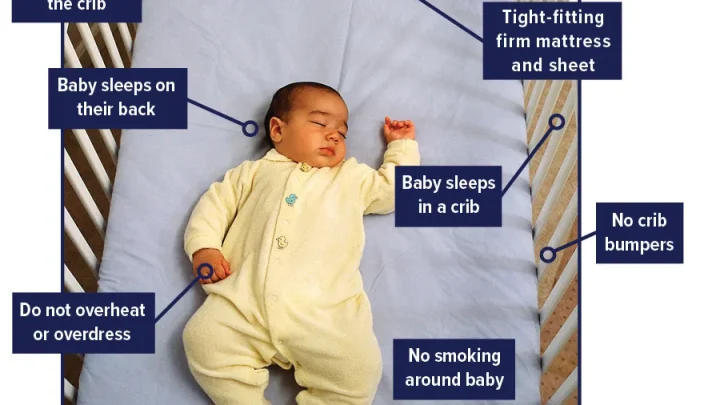
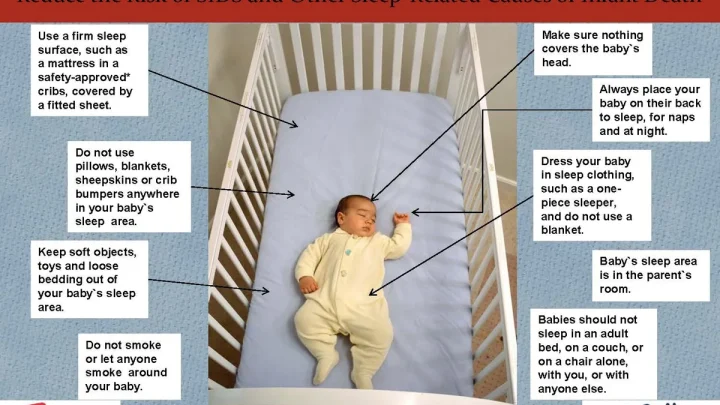
Crib contents stay minimal. Once arms are free, a baby can scoot and grab. That means no loose blankets, pillows, bumpers, or stuffed animals in the crib, ever, through the first year. The sleep sack replaces all of it.
One last rule: swaddling is for the back-sleeping position only. If your baby rolls onto their side or stomach mid-transition, don't roll them back repeatedly at night. That's your signal the transition needs to finish immediately.
FAQs About Stopping Swaddling
How do I know if my baby is trying to roll?
Watch during tummy time. Rocking side to side, getting a shoulder over, or ending up on their back after a tummy session all count. Editorial analysis of parenting forum threads shows many parents miss these early attempts and only learn of the roll when they hear thumps on the monitor.
Can I swaddle with one arm out?
Yes, and it's the standard weaning method. Leave the dominant arm out for three to seven nights, then release the second. It works best when the startle reflex is fading but not gone.
What if my baby rolls onto their stomach while swaddled?
Stop swaddling that night. A swaddled baby on their stomach can't lift or reposition their head and arms, which is the core safety risk. Move directly to a sleep sack and accept a few rough nights.
How long does the swaddle transition take?
Most babies adjust within three to seven nights, sometimes up to two weeks with the gradual one-arm method. Cold turkey to a sleep sack often resolves faster, despite worse first nights. Consistency is the biggest factor in the timeline.
Is it too late to stop swaddling at 5 or 6 months?
No, and it's likely overdue. By that age the Moro reflex is typically gone, so there's no benefit to continuing. Expect two or three rough nights of adjustment, then independent sleep habits usually improve.
Do I need a transitional swaddle product?
Not necessarily. A plain sleep sack works for most babies, which is what the transition process builds toward anyway. Transitional swaddles with removable arms mainly help reflex-heavy babies who struggle badly with the one-arm stage.

Similar Posts